
Chief Uche Nnaji's Renewable Energy Vision Comes to Life as Tinubu Commissions Africa's First Barefoot College
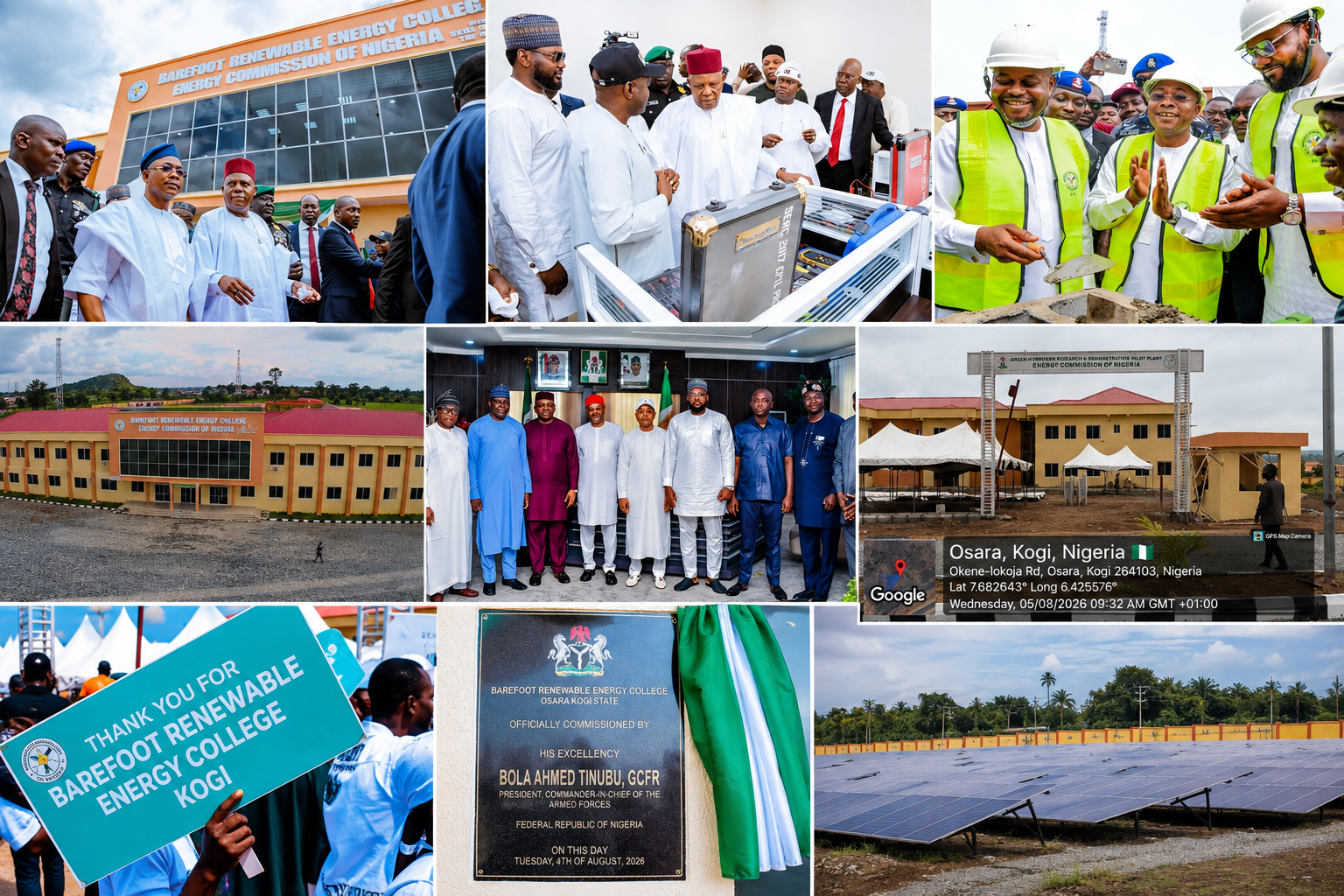
Nigeria has recorded a significant milestone in its pursuit of sustainable development and clean energy with the official commissioning of Africa's first Barefoot Renewable Energy College (BARECKS) at the Confluence University of Science and Technology (CUSTECH), Osara, Kogi State.
The landmark institution, established by the Energy Commission of Nigeria (ECN), was commissioned by President Bola Ahmed Tinubu, represented by Vice President Kashim Shettima, in the presence of senior government officials, traditional rulers, industry stakeholders, development partners, and members of the academic community.
The commissioning represents a major achievement under President Tinubu's Renewed Hope Agenda, demonstrating the Federal Government's commitment to expanding renewable energy education, innovation, research, and workforce development across Nigeria.
The successful realization of the project also reflects the vision and groundwork laid during the tenure of Chief Uche Geoffrey Nnaji, the former Honourable Minister of Innovation, Science and Technology. His leadership played a significant role in advancing policies and initiatives that strengthened Nigeria's renewable energy ecosystem and accelerated the implementation of strategic projects in the sector.
Modelled after India's internationally acclaimed Barefoot College, BARECKS is the first purpose-built institution of its kind in Africa. It is designed to provide practical, hands-on renewable energy training to Nigerians regardless of their educational background, while equipping a new generation of technicians, innovators, entrepreneurs, and researchers with the skills required to drive the nation's energy transition.
The college features world-class infrastructure, including renewable energy laboratories, photovoltaic and solar thermal workshops, battery storage and power electronics laboratories, mini-grid simulation platforms, wind and bioenergy training centres, electric vehicle charging modules, and energy efficiency laboratories.
Speaking during the ceremony, President Tinubu's representative described the institution as a landmark achievement that positions Nigeria at the forefront of Africa's renewable energy revolution. The Director-General and Chief Executive Officer of the Energy Commission of Nigeria, Dr. Mustapha Abdullahi, also described BARECKS as a transformative national asset that will promote research, innovation, skills acquisition, technology development, job creation, and sustainable economic growth.
The commissioning of the Barefoot Renewable Energy College, alongside the Green Hydrogen Research and Demonstration Pilot Plant, is expected to strengthen Nigeria's capacity for clean energy innovation and develop the skilled workforce needed to power the country's transition to a sustainable future.
The project has also renewed conversations about similar renewable energy investments that were initiated for Enugu State during Chief Uche Geoffrey Nnaji's tenure as Minister. Supporters of the former Minister argue that major initiatives, including the proposed ₦40 billion Biomass Renewable Energy Factory and the Renewable Energy Institute at the University of Nigeria, Nsukka (UNN), had the potential to transform Enugu into a major renewable energy hub.
According to these supporters, the projects were delayed and ultimately did not progress as anticipated due to political disagreements and administrative setbacks. They contend that, had the initiatives proceeded as planned, they would have generated substantial employment opportunities, attracted federal investments, and accelerated industrial development in Enugu State.
Regardless of these differing political perspectives, the commissioning of Africa's first Barefoot Renewable Energy College stands as a landmark achievement for Nigeria, reinforcing the country's commitment to renewable energy, technological innovation, and sustainable development while positioning it as a leading player in Africa's clean energy future.
Don't miss a single update
Related Stories

WORLD TEACHERS’ DAY: ODAA OPUO COMMENDS TEACHERS FOR THEIR INVALUABLE CONTRIBUTIONS TO SOCIETY

Odaa Opuo’s Ikem Nkwo Visit Highlights Road Challenges, Community Aspirations and Inclusive Leadership

Chidubem JP Re-Elected as YAN Enugu 5th Assembly Ambassador, Pledges Renewed Commitment to Youth Development