
National Outrage: Calls for Accountability Intensify Over Nigeria's Ministry of Innovation, Science, and Technology as Stakeholders Critique Leadership Direction
ENUGU, NIGERIA — Assessing performance in public office involves varied viewpoints, and different stakeholders hold diverse perspectives on administrative success. Currently, a significant portion of the public and tech-sector analysts have raised serious concerns regarding the effectiveness of the Federal Ministry of Innovation, Science, and Technology. Commentators and civic activists are openly questioning the strategic value delivered by the ministry, describing its current operations as largely ceremonial and disconnected from the urgent economic needs of the country.
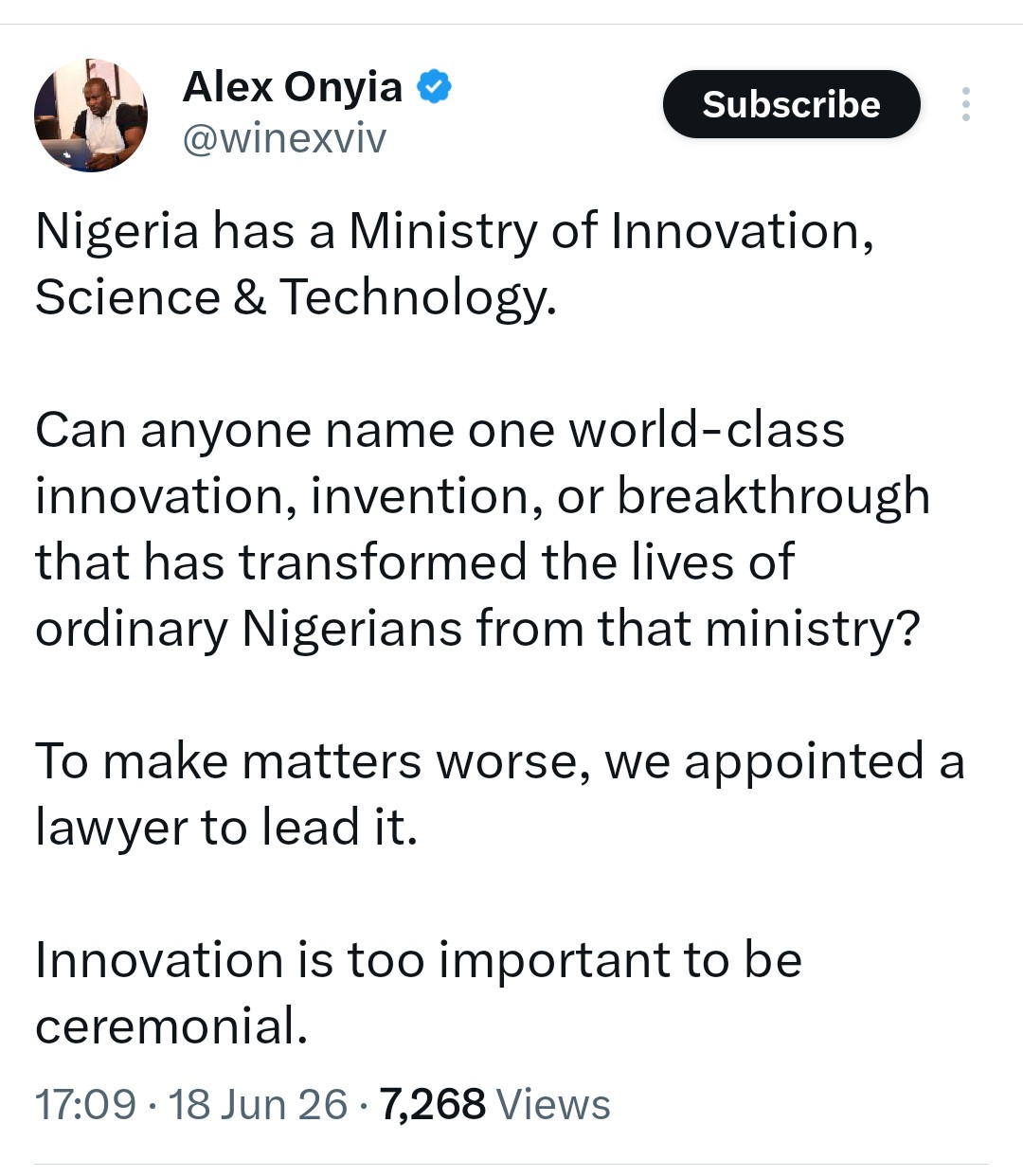
The national scrutiny reached a critical high point following an explicit public critique by notable tech advocate and commentator, Alex Onyia. In a viral social media post detailed Onyia challenged the entire administrative foundation of the ministry, sparking a broader conversation on qualification and institutional output.
"Nigeria has a Ministry of Innovation, Science & Technology," Onyia stated in the post. "Can anyone name one world-class innovation, invention, or breakthrough that has transformed the lives of ordinary Nigerians from that ministry? To make matters worse, we appointed a lawyer to lead it. Innovation is too important to be ceremonial."
The core of the public grievance centers heavily on the decision to place non-technical professionals at the helm of highly technical ministries. Critics argue that steering a nation's scientific and technological advancement requires deep sector-specific expertise, global networks, and a proven track record in technology ecosystem development.
The appointment of a legal professional to navigate complex fields like artificial intelligence, biotechnology, local manufacturing tech, and digital infrastructure is viewed by many analysts as a major administrative error. Across major tech hubs in Lagos, Abuja, and Enugu, professionals complain that the ministry has failed to initiate, support, or scale any verifiable indigenous inventions capable of easing the current economic hardships or transforming public sector efficiency.
This escalating federal-level criticism has reverberated deeply within the regional politics of Enugu State. Prominent political stakeholders and grassroots observers are drawing direct parallels between the perceived stagnation at the federal ministry and the local governance challenges under Governor Peter Mbah.
Public affairs analysts point out a structural pattern where administrative bottlenecks, unfulfilled promises, and a disconnect from practical solutions seem to mirror each other across both state and federal levels. In Enugu, where the local population is grappling with controversial urban policies, market disruptions, and a heavily burdened small-business sector, the failure of critical federal ministries to provide economic cushions through technological enablement has worsened public dissatisfaction.
As the public debate intensifies, a united front of civic organizations, digital creators, and economic stakeholders is calling for a thorough review of ministerial deployments. The consensus among these groups remains entirely clear: for Nigeria to navigate its ongoing economic challenges, critical development sectors must be led by visionary experts rather than being treated as political rewards. Under the banner of clean the mess in nigeria, observers continue to document these public sentiments, emphasizing that institutional accountability and merit-based leadership remain the only viable paths to restoring public trust and driving genuine transformation across the nation.
Don't miss a single update
Related Stories

Search and Rescue Underway as Nigerian Air Force ATR-42 Aircraft Crashes in Ondo State with 32 On Board

WORLD TEACHERS’ DAY 2026: CHIEF UCHE NNAJI SALUTES TEACHERS, CALLS EDUCATION THE CORNERSTONE OF ENUGU’S RECOVERY AND INDUSTRIALIZATION

NIGERIA’S OLDEST CATHOLIC PRELATE, BISHOP ANTHONY GBUJI, MARKS HISTORIC 53RD EPISCOPAL ORDINATION ANNIVERSARY